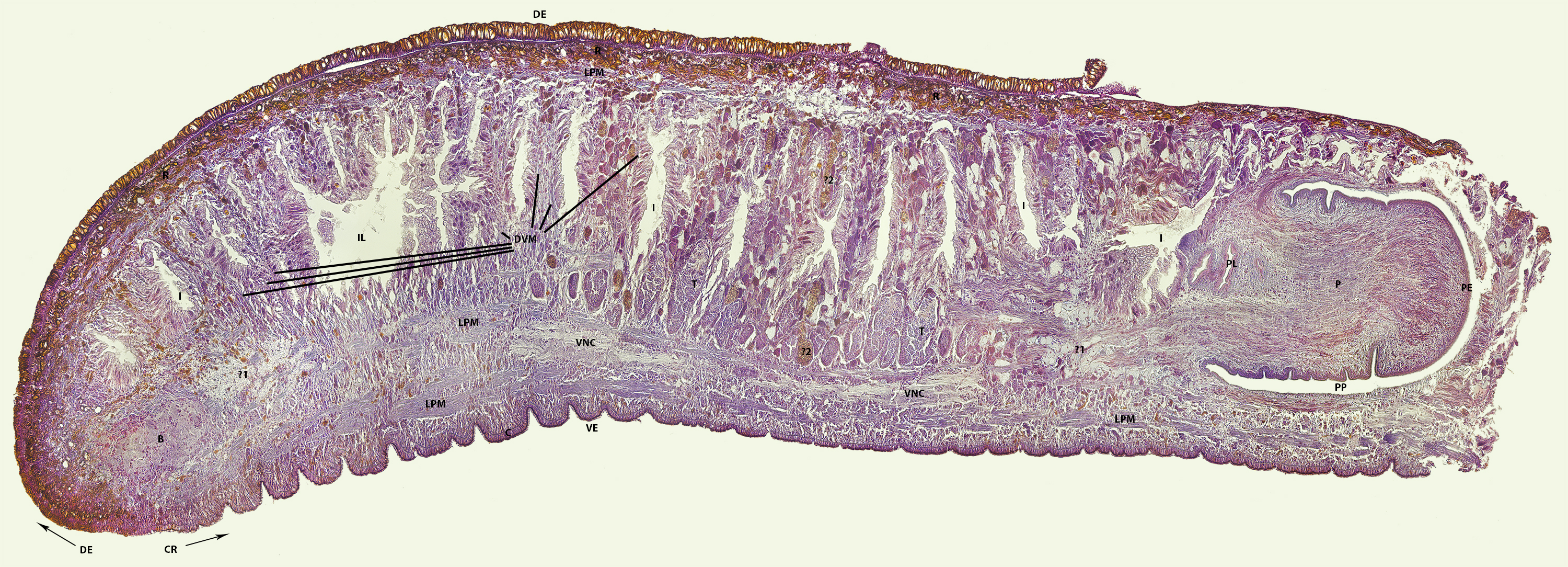
Rare beauty which wasn't in my collection for long time - a land planarian. Microplana [most likely terrestris, 2D reconstruction of gonads needed first] without postpharyngeal part - I accidentally broke the flatworm into two parts, ultimate meh, they are truly incredible delicate specimens. Biggest troublemaker award goes to vitellaria - because land planarians are more glandular and compact creatures than freshwater planarians I got little bit lost in intestines - lot of things going here. `The female gonad of Microplana scharffi and M. terrestris consists of two germaria located ventrally in the anterior third of the body and of paired vitellaria consisting of rows of oblong vitelline follicles distributed along the ventro-lateralmargins between the intestinal pouches - doi.org/10.1002/jmor.10741` Because sample is divided into two separate parts on different slides there is quite big trouble with reverse engineering of oviduct which is connected to common atrium from ventral side. I found the entrance but I'm unsure about successful tracking of any connection to possible yolk gland complex. Oviduct, ovary and seminal vesicle are not present on this slice. Note well visible difference between dorsal epidermis with rhabdites and creeping sole with cilia [creeping sole is area which is used for gliding in land planarians]
Legend: B, brain lobe; C: cilia; CR: creeping sole; DE: dorsal epidermis; DVM: dorsoventral muscles; I: intestine; IL: intestine lumen; LPM, longitudinal parenchymal muscles; P: pharynx; PE: pharyngeal epidermis; PL: pharyngeal lumen: PP: pharyngeal poach; T: testes; VE: ventral epidermis; VNC: ventral neural cord; R: rhabdites; ?1: probably parenchym; ?2: probably vitellaria.
Mallory-Heidenhain, 250x, stitched image.
Sample is interactive https://capi-store.lf1.cuni.cz/histolka/248_Microplana_terrestris/